

In the 21st century, IT networking is the silent engine driving global civilization. Every time you send an email, stream a movie, or check a bank balance, you are engaging with a complex web of interconnected devices. IT networking is the practice of transporting and exchanging data between nodes—such as computers, servers, and IoT devices—over a shared medium.
More than just “connecting computers,” networking is about creating a reliable, secure, and scalable environment where information can flow. As we move further into 2026, the field is evolving from static hardware setups into intelligent, software-defined ecosystems driven by AI and edge computing.
1. The Building Blocks: Core Hardware and Architecture
At its heart, a network is comprised of specialized hardware that manages the flow of traffic. Understanding these components is essential to grasping how data moves from Point A to Point B.
- Routers: These are the “traffic controllers” of the internet. They connect different networks (for example, your home network to the internet) and determine the best path for data packets to travel.
- Switches: While routers connect networks, switches connect devices within a network. They ensure that data sent from a printer reaches the specific computer that requested it, rather than broadcasting it to every device in the office.
- Access Points (APs): These extend the network wirelessly, allowing devices to connect via Wi-Fi.
- Firewalls: The “security guards” of the network. They inspect incoming and outgoing traffic based on a set of security rules to block malicious actors.
Network Topologies
The way these devices are physically or logically arranged is called the topology.
- Star Topology: All devices connect to a central hub (like a switch). This is the most common in modern offices because if one cable fails, only that device goes offline.
- Mesh Topology: Every device is connected to several others. This provides high redundancy; if one path fails, the data simply takes another route. This is increasingly popular in modern “Smart Home” setups and critical infrastructure.
2. The Language of Networks: Protocols and the OSI Model
For two devices to communicate, they must speak the same language. These “languages” are called protocols. The most fundamental is TCP/IP (Transmission Control Protocol/Internet Protocol), which serves as the foundation for the entire internet.
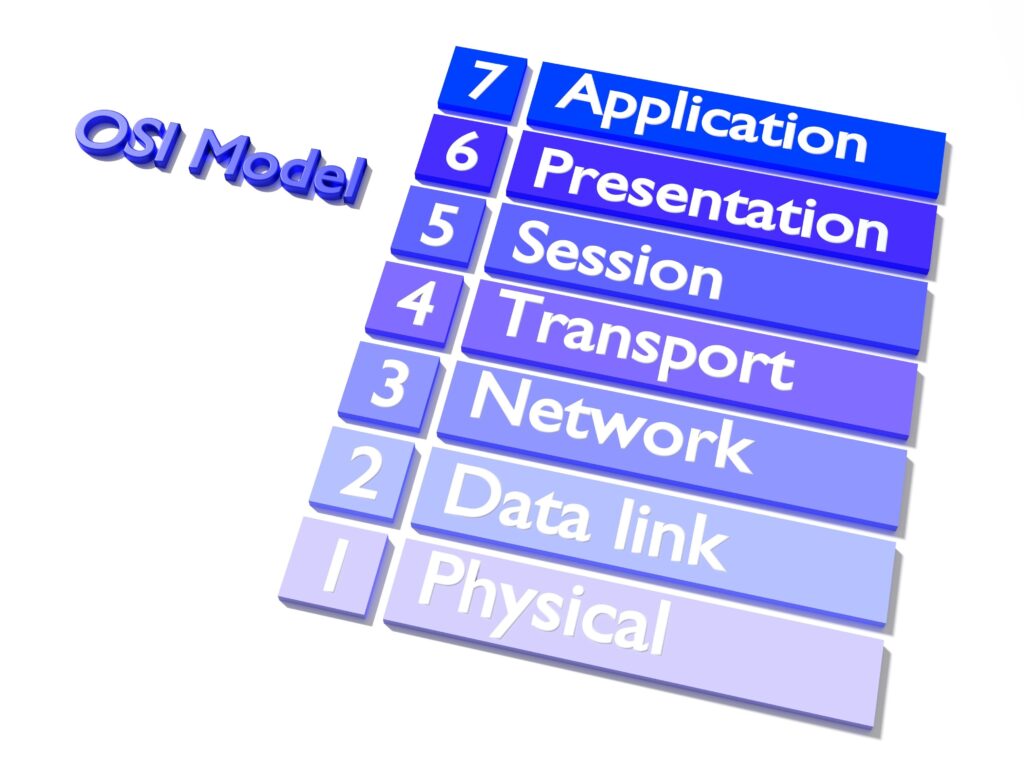
To standardize how different vendors build networking equipment, the OSI (Open Systems Interconnection) Model was created. It divides the networking process into seven distinct layers:
Shutterstock
Explore
- Physical Layer: The actual hardware, cables, and radio waves.
- Data Link Layer: Manages how data is packaged into frames and transferred between two directly connected nodes (using MAC addresses).
- Network Layer: Responsible for routing data between different networks (using IP addresses).
- Transport Layer: Ensures the data arrives intact and in the correct order (using TCP or UDP).
- Session Layer: Manages the “conversation” or persistent connection between two devices.
- Presentation Layer: Translates data into a format the application can understand (encryption and compression happen here).
- Application Layer: The interface where the user interacts (HTTP for web browsing, SMTP for email).
3. Types of Networks: From Personal to Global
Networks are categorized based on their geographic scale and purpose:
| Type | Scale | Common Use Case |
| PAN (Personal Area Network) | Within a few meters | Connecting your phone to your wireless earbuds via Bluetooth. |
| LAN (Local Area Network) | A single building or office | A high-speed office network for sharing files and printers. |
| MAN (Metropolitan Area Network) | Across a city | A university campus or a city-wide public Wi-Fi system. |
| WAN (Wide Area Network) | Countries or Continents | The Internet itself is the ultimate WAN. |
| VPN (Virtual Private Network) | Virtual/Over the Internet | Creating a secure “tunnel” for remote workers to access private office files. |
4. Modern Trends: The Shift to Intelligence
The “old way” of networking involved manually configuring individual boxes of hardware. Today, the industry has shifted toward Software-Defined Networking (SDN). In SDN, the “brain” (control plane) of the network is separated from the hardware (forwarding plane), allowing administrators to manage the entire network through a single software interface.
The Rise of AI and “Agentic” Networking
In 2026, we are seeing the rise of AI-native networks. These systems don’t just wait for a human to fix a problem; they use machine learning to predict traffic congestion and reroute data automatically. Self-healing networks can now detect a failing switch and isolate it before users even notice a drop in performance.
Edge Computing
With the explosion of IoT (Internet of Things) devices, sending all data to a central cloud server is becoming inefficient. Edge Computing brings the “processing power” closer to the source of the data—like a smart factory floor or a self-driving car—to reduce latency and improve speed.
5. The Critical Pillar: Network Security
As our lives become more connected, the stakes of networking failure or intrusion have never been higher. Modern network security is no longer just about having a strong password; it follows the Zero Trust model.
In a Zero Trust environment, the network assumes that every user and every device is a potential threat. Access is only granted after continuous verification of identity and device health. Key security technologies include:
- Encryption: Scrambling data so it cannot be read if intercepted (e.g., SSL/TLS).
- Intrusion Prevention Systems (IPS): Monitoring the network for suspicious patterns and blocking them in real-time.
- Network Segmentation: Dividing a network into smaller “islands” so that if a hacker gets into one part, they cannot easily move to another.
6. Conclusion: A Career in Connectivity
IT networking is more than a technical discipline; it is the infrastructure of modern life. For those looking to enter the field, the path usually begins with foundational certifications like the CompTIA Network+ or the Cisco CCNA.
As we look toward the future, the role of the network engineer is changing. It is moving away from physical cabling and toward Network Automation, Cloud Integration, and Cybersecurity. In a world that never goes offline, the experts who keep the data flowing will always be the gatekeepers of the digital frontier.